The
Bottom Line on
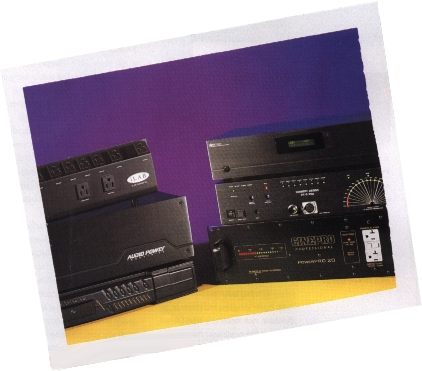
Line Conditioners
What do those fancy line conditioners
do that a $10 power strip doesn't?
More-and less-than you might think.
by Brent Butterworth
|
The
Bottom Line on
|
Line Conditioners |
|
|
What do those fancy line conditioners
do that a $10 power strip doesn't?
|
||
|
More-and less-than you might think. by Brent Butterworth |
||
Home Theater March 1999
There's so many things to be concerned about when you're putting together
a home theater that you have to ignore something. AM/FM tuners, for example-who
really cares how good the tuner is inside their receiver? Or videotape-when's
the last time you actually sought out a certain brand?
Then there's the things you maybe can ignore. Do you really care how
your speaker cable affects your sound? Maybe. Do you care how good or bad your
VHS VCR is? Maybe.
For most of us, the AC coming out of the wall falls into that "maybe" category.
Most people know that electrical spikes and surges can damage your audio/video
gear. But beyond that, is wall AC OK? Or does it need further refine ment if
the components it powers are expected to reach peak performance?
A few weeks ago, we didn't know. Since then, we ve spent a lot of time Irving
out line condi tioners of every price, size, and configuration. We've plugged
them into our systems, tried all of their features, and compared them in a blind
test to see what effect they have on the picture and sound of a typical home
theater system. And we've come to some conclusions that, frankly, surprised
us.
What's Wrong With Wall AC?
AC is one of those things we never think about-even most electronics textbooks
con sider it to be a simple, 60-Hertz, 120-volt RMS
sine wave, and mention any impurities only in passing. But it's not that simple.
Hook up an oscilloscope to a wall outlet, magnify the image enough, and you'll
see little ripples riding along on the big 120-volt wave. Those little ripples
are the result of radio-frequency and electromag netic interference, from sources
like radio, fluo rescent lights, motors, and high-frequency switching in appliances.
The switching power supplies used in most computers are a notori ous source
of such interterenc~they switch power from the AC line on and off at very high
frequencies, thus causing small fluctuations in the voltage all of your other
appliances receive.
RFI and EMI don't harm your audio/video gear, but they can affect its performance.
Everyone's heard the results in extreme cases of interference-the buzz from
an electric razor coming through your stereo system, for exam ple. Many audio
and video enthusiasts consider RFI and EMI to be harmful in more subtle ways,
though, degrading the sound and pic ture in ways that aren't obvious to the
casual observer, but clearly audible and visible in high-end home theater systems.
All power supplies, though, filter out almost all EMI and RFI. Most audio/video
components include fairly large filter capacitors in their power supplies. These
capacitors are designed to filter out the 120-Hz hum coming off the power supply's
rectifier: they also filter out any frequency above that. If these caps can
filter out high-amplitude 120-Hz ripple to the point of inaudibility, they'll
certainly do something to
filter out, say, 90-megahertz RF interference with a strength of a few microvolts.
Many high- end audio manufacturers also add small "bypass" capacitors across
the big power- supply caps: these can, in some cases, do a better job of filtering
out high~frequency interfer ence than the big caps can. Some manufacturers who
go to great lengths in designing their pow er~supplies actually recommend that
you use no line conditioning at all: they feel that many line conditioners limit
current to a point that outweighs the benefits of the additional RFI and EM
filtering.
If you're watching the oscilloscope at just the right time, you might notice
a spike-a very short pulse of high-voltage electricity. Most people think spikes
come from lightning, and, of course, they do. But they can also come from your
appliances. Usually, spikes are the res~lt of a phenomenon called "inductive
kick." This occurs when the electricity feeding into an inductor (for example,
the armature winding in a motor, or the primary winding of a transformer) shuts
off. The inductor discharges, throwing voltage back the way it came, into the
AC line. If there's a switch between the transformer/motor and the AC line,
the voltage coming back from the inductor can build up to such high levels that
it can even arc across the switch contacts and find its way back into the AC
line.
Spikes can permanently damage your home theater system. A lightning spike can
burn out critical components on a circuit board in a frac tion of a second.
Milder spikes, like those from appliances like refrigerators and air condition
ers, can sometimes do immediate damage, but often do their damage over time.
(I learned this when I worked as a copy editor at Spin maga zine, which
was headquartered in a beat-up old New York City office building. Thanks to
the spikes thrown off by the building's ancient elevators, I spent a lot of
time replacing power supplies in the editorial department's computers.)
Spike protection, even in inexpensive devices, is generally considered to be
very effec tive nowadays-that's why you see so many power strips that offer
a warranty that replaces any gear connected to the power strip that's damaged
by spikes. Some of these warranties cover up to $50,000 worth of gear.
Protection from RFI and EMI, though, isn't guaranteed, and effects on audio
and video per formance can be tough to prove. Thus, we decided to line up a
random selection of line conditioners priced from a couple hundred bucks to
a couple thousand bucks, plug 'em into our system, and find out if we could
hear or see a difference.
The Face Off
To test the line conditioners, I enlisted assistant editor
Joe Hageman and contributing editor Steve Gutten berg as panelists, in addition
to myself. For them, the test was blind: They had no idea which line conditioner
was plugged in at
any one time. I performed all the switching. We used a relatively high-end system,
including Aerial Acoustics 7B, CC-3, and SR-3 speakers, a Sherbourn 5/1500 amp,
an Acurus ACT3 pream p/p rocessor; a Sony DVP-53000 DVD player, and a Zenith
lnteq 36-inch TV. I plugged all of the components into each line conditioner
in turn, and plugged each line conditioner into one of the 20-amp circuits (with
medical-grade outlets) in our New York listening room. At the beginning of each
test run, and then once again halfway through, we plugged all the
gear straight into the wall to remind us how the system performed with no line
conditioner in place. To make the test more difficult, I plugged a computer
with a switching power supply into the same AC circuit. Even without that, though,
this
should've been a tough test-it took place in a New York City skyscraper with
elevators, huge heating/air conditioning systems, and thousands of computers
running all at once.
Our test included products in a wide range of prices, from ILab's $199 Auto
Strip Model 8 to Cinepro's $1,800 Power- PRO 20. We received more products for
this test than we could evaluate in a single article, including lower-end products
from Audio Power Industries and Panamax, an affordable, rack-mount strip from
Leviton, and a new line conditioner from Monster Cable: we'll get a review of
these in as soon as we can.
Before we go further, understand that your results may vary, especially if you
have a "problem" component in your system that's extremely susceptible to interference,
or that has poor grounding. All of the components we employed in this test have
been working well, and we haven't experienced any obvious interfer ence or grounding
problems in our New York listening room.
B. The Ultra 115 sports nine outlets, but for $1,500 we'd like to see more.
Audio Power Industries
Audiophiles can be insanely faddish, moving from one "miracle"
product to the next in search of perfection. It's even hap pened with line conditioners,
but there's one name that continues as a fixture in audiophiles' sound systems
no matter what the current fad might be: Audio Power Industries. This company's
Power Wedge line conditioners win raves from audiophiles year in and year out.
The $1,499 Power Wedge Ultra 115 is the company's top-of-the-line product. It
offers nine outlets, of which there are three types. One supplies up to 300
watts: it's intended for use with your TV. Four outlets supply power (up to
15 amps) for ampli fiers. The remaining four outlets supply up to 120 watts
each: they're for use with source devices and preamp/processors, and they're
isolated so that electrical anomalies thrown off by one component can't enter
the other components through their power lines. This isn't a lot of outlets
for $1,500, obviously, and we could use more isolated outlets. Also, the Ultra
115 offers no current-sensing or remote- switching capability.
The Ultra 115 contains a center-tapped input transformer, which converts the
AC power from unbalanced to balanced. Let's explore that a little further. The
AC from your wall has three conductors, one "hot," one neutral," and one "ground."
The hot and neutral carry the actual AC power: the ground is intended as a common
reference for all your electrical appliances, although ft's simply connected
to the neutral line back at your home's breaker box. Thus, the voltage potential
of the ground is essen tially the same as that of the neutral line. In a balanced
AC system, though, the ground is at a potential between that of the hot and
neutral lines-at the top of the AC sine wave, the hot is at +60 volts, the neutral
is at -60 volts, and the ground is at 0 volts. Line conditioners typically shunt
noise and spikes to ground, but remember, the ground's connected to neutral
further up the line. Thus, it's theoretically more effec tive to have a completely
separate ground, combined with balanced AC lines.
The Ultra 115 has a switch for each of the 120- and 300-watt outlets, which
lets you select between floating (disconnected) ground, unbalanced AC, and balanced
AC, we used the balanced setting for our testing. Joe and I both felt that the
Power Wedge Ultra 115 let our system achieve the best performance we heard in
the Face Off. (Joe ranked it number one: I tied it with the Cinepro PowerPRO
20.) Joe felt that it brought out the subtlety of Foley effects in soundtracks.
I thought the soundstage on music cuts deepened, and percussion sounded more
detailed. To me, the improvement we got from the Ultra 115 sounded to me like
what you'd get by switching to a slightly better digital-to- analog converter.
On the Desperado DVD, the dialogue actually sounded spittier and harsher,
but I suspect that's because the Ultra 115 helped the system reveal the flaws
in the recording. Steve, however, ranked the Ultra 115 only fourth out of six
line conditioners: he felt it cleaned up the midrange but thinned out the bass.
The improvements we heard with the Ultra 115 were certainly subtle for $1,500,
but in a high-end system, this device makes sense.
Cinepro
Cinepro's best known for insanely high
powered amplifiers, but the company also
offers a selection of line conditioners,
the most expensive of which is the $1,799.
PowerPRO 20. Like the API Power Wedge
Ultra 115, the PowerPRO 20 offers balanced
AC power, although doesn't offer the
options of floating ground or unbalanced
power, as the Power Wedge does. It has
front outlets: on the rear, there are four
isolated outlets for digital gear, and eight
more outlets intended for analog gear. That's
a lot of outlets, although we'd like to see more isolated outlets. As with the
Power Wedge Ultra 115, there's no provision for remotely switching the outlets
on or off.
I thought the PowerPRO 20 sounded about as good as the Power Wedge Ultra 115:1
was surprised at how kick-ass and dynamic the system
sounded when we plugged everything in to this conditioner. The soundstage got
bigger, and the sound became more detailed and delicate. The only difference
I heard between the API product and this one is that the PowerPro seemed to
yield a more deliberate and cleaner, but less airy, sound~I felt it was really
a chocolate- versus-vanilla thing, rather than a clear case of one being better
than the other.
Steve and Joe, however, weren't as impressed by the PowerPRO's perfor mance
and ranked it fifth out of six. They both felt that it improved the sonic detail
and seemed to do a great job of eliminat ing background noise. But Joe felt
that the sound seemed brighter in a way he didn't like. I have to wonder, though,
if Joe was really hearing more of the actual quality of the recording that was
masked by the lesser line conditioners.
Even if Joe and Steve don't agree with me, I think Cinepro's got a nice product
here. At $1,800, it's $300 more than the API Power Wedge Ultra 115, which offers
five fewer outlets, but similar (maybe even slightly better) performance.
Current Design
When they started designing the PC-B Plus line conditioner,
Current Design sought out the advice of several custom installers, who suggested
lots of extra features most people wouldn't think of including. Thus, the $895
PC-B Plus comes fully loaded. It's also designed for outstanding performanc~
there's no need for separate digital outlets or separate high-current outlets,
because all the AC traces on the circuit boards are extra-beefy half inch on
both sides of the board) to handle high current, and all of the outlets are
isolated from each other, with individual filtration for every outlet, to pre
vent electrical anomalies thrown off by one component from sneaking into other
com ponents through the AC line. You can pretty much plug in anything to any
outlet.
The PC-B Plus's back panel has eight outlets. All are spaced to accommodate
wall warts (the little AC adapters that come with so many products these days),
and the top ones are turned upside down for the same reason. One of these outlets
is unswitched (for your VCR or anything else that needs constant power), and
another includes current-sensing, so that when you turn on whatever's plugged
in to this outlet, the whole system fires up. (You can also flip a DIP switch
so you can just use this as an unswitched outlet.) Each of the six remaining
outlets can be configured as switched or unswitched. The outlets fire up and
shut down one after the other, and you can adjust the delay between the out
lets, so there's little chance of pops caused by turning on your source devices
when the power amp's on.
There are also three pairs of F-connectors for antenna/cable/satellite
input and output; these provide spike protection on all your RF lines. (One
is completely isolated from the chassis, which might help you eliminate a ground-loop
problem if it exists.) There are 12-volt inputs and out- puts, so you can fire
up the PC-B Plus from a pre/pro, a projecfor, or any other device that puts
out a 12-volt trigger, and you can also use the PC-B Plus to activate any device
with a 12-volt trigger input, like a motorized screen or a lighting controller.
There's a phone line input/output pair, too, for spike protection on the phone
line for your Divx player, WebTV box, or satellite receiver. This pair actually
uses RJ-45 lacks with protection for two lines, so if you use RJ-45-to-RJ-1
1 adapters, you can protect two phone lines.
The front panel offers adjustment trim mers for the current sensing (so it'll
work even with a component that draws very little current) and turn-onnurn-off
delay. There's also a master on/off switch, an incoming AC voltage meter, and
an XLR socket that accommodates an optional Littelite, the same kind of equipment
light used on mixing boards.
The PC-B Plus seems to perform well- Steve picked it as his second favorite,
saying that the sound opened up, the instruments in the music tracks sounded
cleaner, and the Foley effects on DVDs sounded
clearer. I felt exactly the same way, placing the PC-B Plus in the same tier
as the API Power Wedge Ultra 115 and the Cinepro PowerPRO 20. I thought every
thing sounded cleaner than with the line conditioners in the second tier, and
I thought the background noise was remarkably low. Joe, however, was com pletely
at odds with Steve and me, saying the PC-B Plus made the system sound hashy
and bright.
At $895, this product is not inexpensive, but it really seems to have some high-horsepower
line-conditioning cir cuitry inside, and it's got a great feature package to
boot.
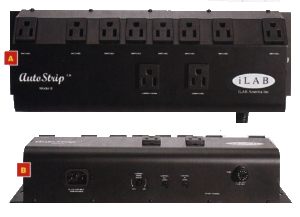
A. With its $199 price tag ( not to mention glowing reviews from two editors
) the AutoStrip Model 8
was dubbed the bargain of the face-off.
B. There's 10 outlets in all, with 8 switched ones onthe back, and two more
on top ( one unswitched and
the other a current sensing outlet).
ILab
America
Everyone's seen a power strip before- there's
one under almost every desk in America. ILab's $199 Auto Strip Model 8 is sort
of like the most deluxe power strip you've ever seen. It has a total of 10 outlets.
Eight are switched; four of these are spaced from the others so you can easily
insert a wall wart.
There are two more outlets on top. One is unswitched, for powering a VCR or
any other device that needs power 24-7. The other is a current-sensing outlet-when
you switch on the component plugged into this outlet, all of the switched outlets
will turn on. A small knob on the side lets you adjust the current sensing.
The Auto Strip Model 8 also has an IEC type socket and a detachable power cord,
plus minijacks for 12-volt trigger input and output. Thus, you can power up
the AutoStrip by sending it 12 volts DC (as put out by some pre/pros and most
projectors), and it can also send out a 12-volt trigger to acti vate motorized
screens, lighting controllers, etc. Also, the AutoStrip has two mounting holes
that make it easy to secure to the side of a wooden cabinet. This is a pretty
amaz ing number of features for a $199 product. Although the AutoStrip has fairly
basic surge/spike suppression and simple line- filtering circuitry, Steve actually
felt it made the system sound better than with any other line conditioner. "It
sounds the most different," he said. "The image is substantially bigger, there's
more detail, and the sound is clearer overall. The bass sounds more like real
bass." (Steve had the sweet spot throughout this test, too, and as a hardcore
audiophile, he's usually a pickier listener than Joe and I.) Joe liked the AutoStrip,
too, raving about the sonic detail and saying it made the system sound almost
as good as it did with the API Power Wedge Ultra 155 and the XS Technologies
Strata 1000. I, however, felt the system sounded the same with the AutoStrip
as it did with straight wall AC.
With
so many useful features, rave reviews from two editors, and a very reasonable
price, this little device has to rank as the bargain of this Face Off. It's
not available at retail, but you can order it through an 800 number or through
the company's Website.